Eight Legs, Zero Schedule
READING // OTHER MINDS: THE OCTOPUS, THE SEA, AND THE DEEP ORIGINS OF CONSCIOUSNESS

“When you dive into the sea, you are diving into the origins of us all.”
― Peter Godfrey-Smith, Other Minds
My daughter would like to know about the color-coding on my iCal, so I explain it to her. Purple blocks are work projects, which I can wiggle around a bit, but dark purple is for work meetings; those blocks can’t be moved. Red is for personal things, green is for Jon’s appointments, dark green is for kid activities, and brown is for house stuff like a handyman or a vet appointment. Yellow is when Nana is coming up.
“Why aren’t there any orange blocks?” she asks.
“Because orange is for exercise,” I say.
My daughter wants to know, if I lost my phone and my computer, would I still have to do all those things? I attempt to explain The Cloud, which goes no better than when I tried to explain how babies are made or why people are so into Jesus. It’s not that I don’t want to get into it, it’s that I immediately find myself getting into too much detail and having to back out before she gets confused or disturbed.
The octopus does not have any of these tedious human issues. The octopus doesn’t micromanage its schedule and apparently can’t even see color, so an expertly cataloged iCal would be meaningless to this creature. We aren’t sure of that, of course, but their eyes lack the photoreceptors to make color vision possible in the way we currently understand it.
This is a curious fact if you consider that the octopus is able to change its skin color not just for simple camouflage but for seemingly complex communication around mating, security, and predatory behavior.
An octopus in the sea might flash from a mottled green-gray to a brilliant mosaic of subtle shades of red—and back—in a moment. It possesses the ability to project clouds on its own skin to mimic the sky and fool animals in the water underneath. Its skin is effectively a projection screen with zillions of tiny disco-ball cells that can reflect light and saturate with hue instantly. What a wild thing!
“Mischief and craft are plainly seen to be characteristics of this creature.”
—Claudius Aelianus, third century A.D., writing about the octopus
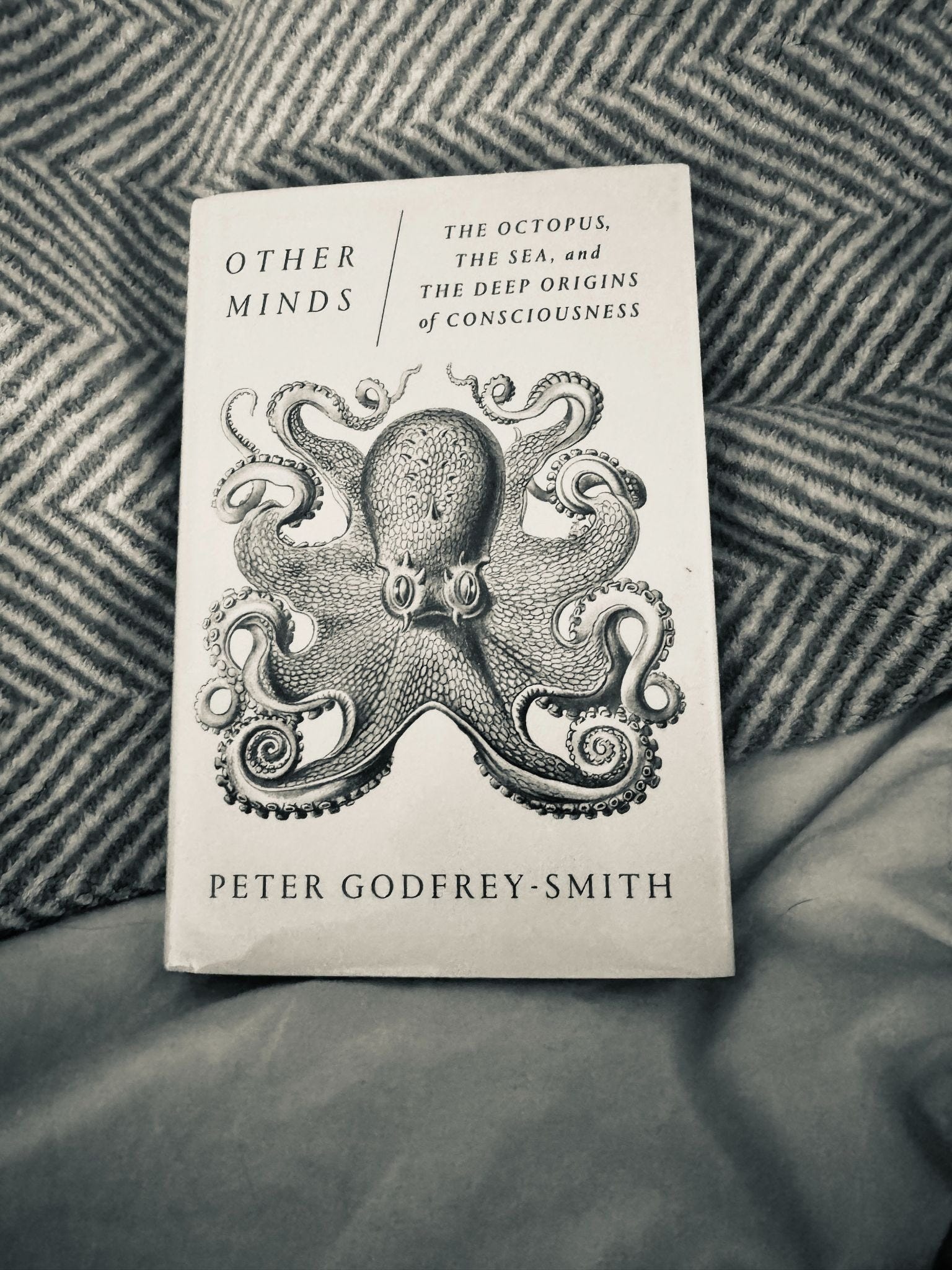
Other Minds, by Peter Godfrey-Smith, is subtitled “The Octopus, the Sea, and the Deep Origins of Consciousness,” and that’s pretty much exactly what this book is about.
If you have had the occasion to have a casual in-person conversation with me in the last week since I began reading this book, no matter the setting or the subject, I have probably managed to find a way to bring it around to talking about octopuses. This is at least the fourth book* I’ve read about this order of animals, Octopoda, which contains at least 300 distinct types of octopus.
So here’s the deal. Our most recent common ancestor to the octopus, according to evolutionary biology, was a primitive, worm-like creature that lived approximately 600 to 750 million years ago. This was so long ago that bilateral symmetry had not happened yet, meaning animals hadn’t developed into a “left” and “right” side of their bodies. It was also long before the invention of brains and nervous systems, for that matter.
Yet, independently, humans and octopi each went on to develop bilateral symmetry, brains, nervous systems, and modern eyes. This is pretty much all we have in common with the octopus; otherwise, this creature developed independently across millions of years of evolution. For this reason, Godfrey-Smith writes: “The octopus is the closest we will come to meeting an intelligent alien.”
Octopuses, with their highly developed nervous systems, which allow them to independently “think” in not just their big bulbous brains but independently in each of their eight legs, for all their sophistication and intelligence, live only for a year or two. All that brain development for quite a short life, and the females, at least, die as soon as they have fulfilled their destiny of more octopi.
But while they live, they are indeed remarkably bright creatures.
★ If you, like me, are enthralled by octopuses and can’t get enough, perhaps you’ve also read the incredible novel Remarkably Bright Creatures by Shelby Van Pelt or the bewitching non-fiction The Soul of an Octopus: A Surprising Exploration Into the Wonder of Consciousness by Sy Montgomery, both of which I recommend highly. My Octopus Teacher is a beautiful documentary.
Along with their flashy color-changing tricks, they’ve been known to solve complex puzzles when tested. With their lack of a skeleton, that can craftily sneak out of even the tightest holding tank when held against their will. When trapped in labs, they’ve been known to purposely squirt water at their least favorite humans by using jet propulsion through a tube-like siphon they just happen to have handy near their head. Here is a cute NPR story about an octopus named Otto who would systematically short out the entire electrical system and shut off the lights at Germany’s Sea Star Aquarium by strategically aiming water at the ceiling lights.
They’re clever, crafty tricksters highly prone to doing things their own way.
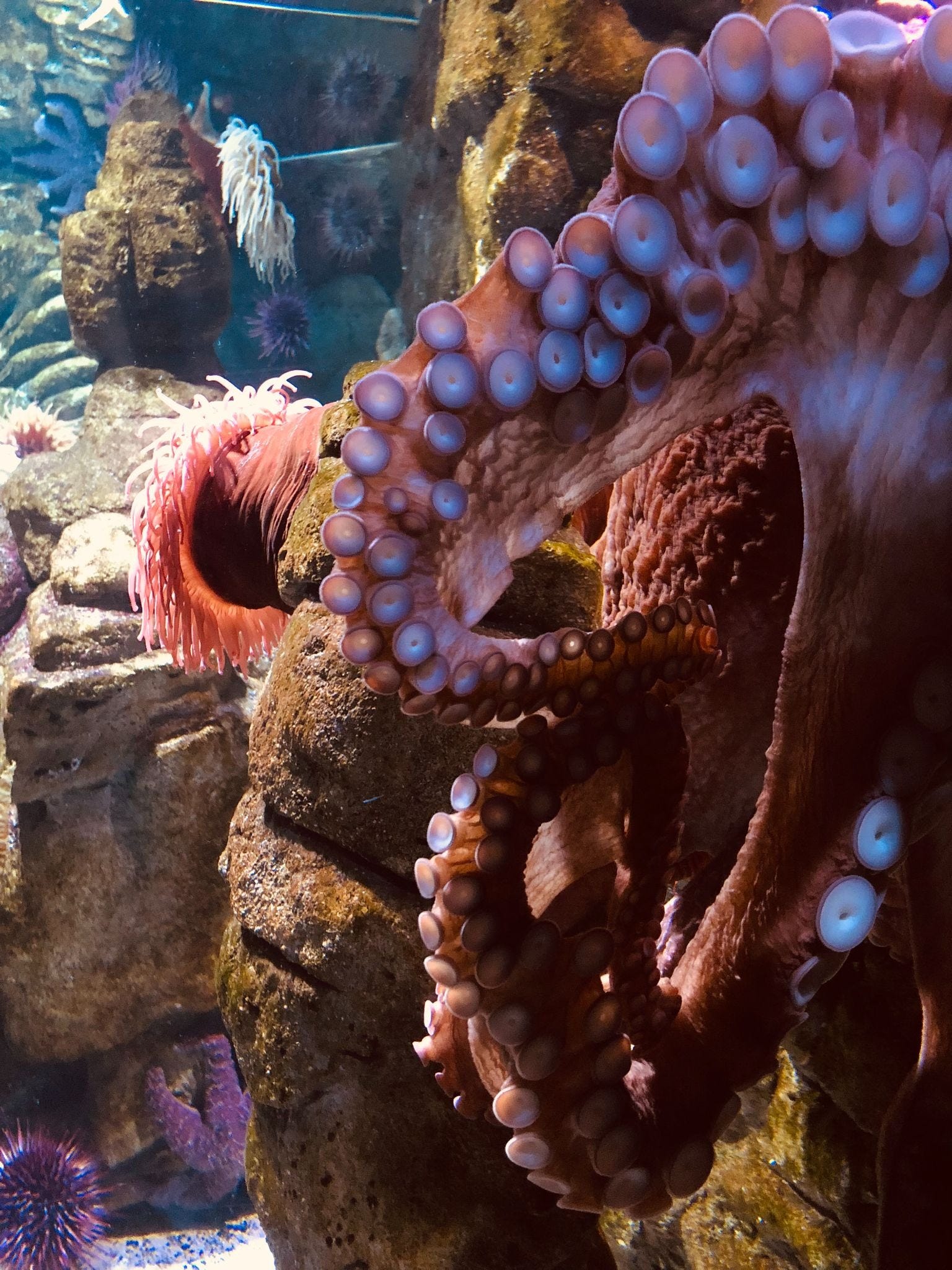
Here is a random shot I took at the New England Aquarium some years back. I only got one picture because, well, I was chasing my kids around.
My daughters, too, are highly willful and super into pranks right now. They’ve told me that April Fool’s Day is their favorite day of the year, and they wish it was a whole week. I’m sure the octogenarian teacher’s sub who sat on their whoopie cushion would disagree.
By the end of this full-moon April 1st, I had been doused with ice water carefully rigged behind my bedroom door. When I opened the bathroom cabinet to reach for my Ursa Major face cream, a dead moth tumbled into the sink. By the time I got into bed, I was on edge and praying for the day to be over. My daughters, giggling madly, stared at me as I began to pull down the covers. I knew there was another horrid prank awaiting me, so I carefully checked under each blanket and all the pillows, then investigated all around my bed. I opened the nightstand drawer, flipped through my book, and scrutinized the room, trying to deduce what evil fate awaited me, while all the while, they giggled madly.
Stumped, I got into bed and pulled the covers up. They stared at me, identical twins with a maniacal glint in their eyes. It was deeply unsettling. Ignoring them, I reached for my bubble water, which I always place next to the bed in a mason jar with a plastic sippy cup lid screwed onto it. I took a sip.
BLECH!!
They had replaced my bubble water with an identical cup of regular water tainted with hot sauce.
The octopus is an enigmatic creature, and they’ve proven notoriously hard to investigate in lab studies. They’re solitary and can’t be housed together or they will fight. They’re incredible at escaping confinement and can fit through very tiny spaces. Inky, a basketball-sized octopus in a tank at the National Aquarium of New Zealand, made national news when he, in the words of NPR, “squeezed through a slight gap at the top of his tank, flopped to the floor, then slithered about 8 feet overland to slide down a drainpipe more than 160 feet long and, finally, to plop into the bay.” Never to be seen again.
My daughters can also contort themselves into strange scenarios and get themselves into troubles beyond a mother’s reasonable imagination. At eleven, they fight mercilessly, a constant competition for dominance. Unlike octopi, they don’t have the option of finding a solitary ecosystem to exist in, so the battle wages on. In the ruthless deep seas of parenting, I am the hermit crab, trying to co-exist with the octopi, but always on edge and desperately scrambling for cover, a timid little homebody overwhelmed by the sheer force of my octopodal roommates.
★ Speaking of the word octopodal, another movie I saw recently and have to share, Come See Me in the Good Light. Breathtaking.