Passing Time
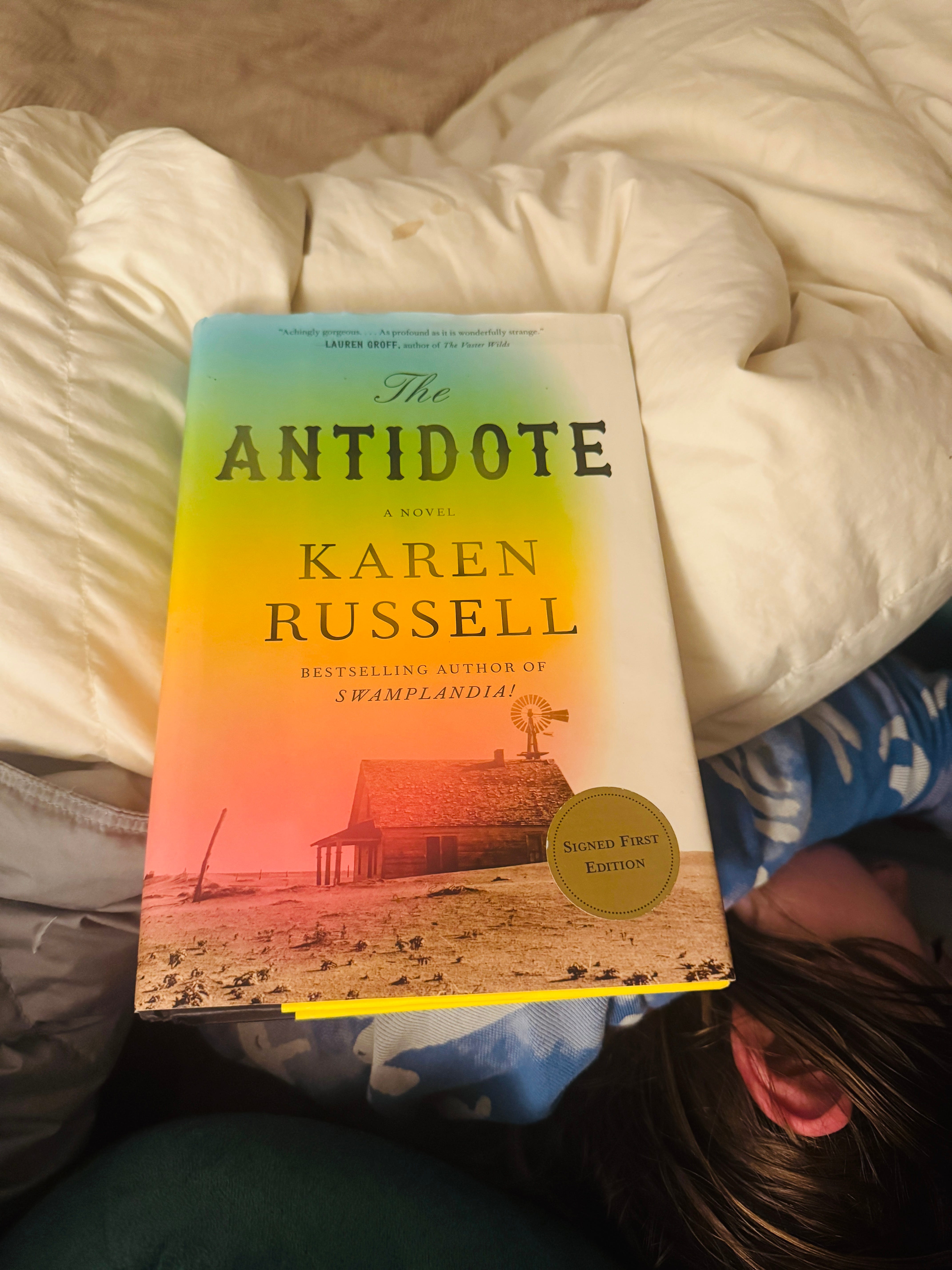
READING // THE ANTIDOTE

It was Spirit Week at my daughters’ school, and their assignment for Thursday was to “dress like another decade.” They could choose the decade. Thus ensued a lot of conversation about what it was like, and I quote, “way, way back in the olden times, like the late 1900s.” In other words, when I was growing up, which doesn’t feel that long ago to me.
I suggest they dress like flappers in the ’20s, to which they confusedly respond “But it’s the ’20s right now.”
God I’m old.
They finally settle on the ’60s, mainly because we have the stuff they need to pull a costume together: dayglo dresses, wacky sunglasses, flower-power accessories, and a pair of too-small leggings we cut up to make groovy headbands.

“I had by this point heard many rumors about these ‘Vaults,’ women who by some kind of occult art could store men’s memories outside of their bodies.”
— Karen Russell, The Antidote
Another decade long, long ago in ancient times: the ’30s, when the Dust Bowl blanketed the midwest in a stifling economic and spiritual depression. I just read The Antidote, a story set in fictional Uz, Nebraska, during this era.
There’s a lot going on in this book, which combines historical accuracy with magical realism and prescient climate warning. There’s a farmer, Harp Oletsky, whose crops are strangely untouched by the dust storms that destroy everything else for miles around. There’s the unnamed scarecrow, whose first-person entries hint at a real past life that ended in mortal exile on a stick in a field somewhere. There’s Cleo Allfrey, a wandering FSA photographer assigned to capture White plight in the suffering Great Plains, but whose camera mysteriously records past and future times on the same land—”historical truths” which include the thriving lives of the Pawnee, who actually knew how to take care of this land before being driven off by Polish settlers with zero clue.
And there’s the Prairie witch, a “Vault” known as the Antidote. Vaults take men’s saddest, hardest memories from them and store them hidden inside themselves until the giver wants their “deposit” back.
To be able to forget: a dubious wish.
The men in this place harbor a lot worth forgetting. They’ve decimated the Pawnee population. They’ve ruined the land for farming and living. They’ve committed atrocious crimes. As a backdrop, the unsolved murders of countless women haunt the town of Uz.
The teenaged daughter of one murdered woman, Dell Oletsky, sits at the center of the story. A misfit basketball player without a coach, she’s determined to lead her team to the championships. They practice every day on an outdoor court where they can barely see for the dust clogging the air.
In time, Dell becomes an apprentice to the Vault, hiding in the closet of her motel room while the Vault takes deposits from townspeople, often at the behest of the Sheriff, who is determined to keep order in the town (and win the next election) by whatever means necessary. The Vault doesn’t hear the deposits she takes because she’s in a trance, but from the closet, Dell does.
“A prairie witch’s body is a room for rent. A vault to store the things people cannot stand to know, or bear to forget.”
― Karen Russell, The Antidote
One can either be the persecuted or the persecutor, it seems.
Like the Polish who settled Uz in The Antidote, many of my ancestors came to America to escape persecution in England. They wanted the right to worship in their own way, far from the oppressive hands of the King’s Christianity. Others made their way first west from France and then south from New France (today’s Quebec), driven by poverty and desperation.
But of course, their arrival in the new world destroyed the civilizations that were here before them. They brought their diseases, their weapons, and most formidably, their capitalism. And with their move, they went from oppressed to oppressor, just as in The Antidote, Polish refugee farmers became the de facto persecutors of the Pawnee in the new world—and ruined their land as well.
Why can’t there be room for us all?

It seems to be human nature to compete over resources and ideologies, a truth I see mirrored in my identical twins every day. They fight over clothes, toys, art supplies, headbands, who gets to choose pink as a favorite color. They fight over noises, personal space, ownership of ideas. Most of all, they fight over me—who gets to sit on my lap while we watch a movie, who gets to fall asleep next to me, who gets to show me their ballet moves first.
Sharing is anathema; the sole goal is to triumph.
As my daughters have grown older, the scrabble for resources has gotten more sophisticated. Where biting used to be their biggest problem-solver, now, they argue with words, which enables them to say terrible things to each other. As the omniscient narrator, I struggle with whether to referee the fights or simply observe.
“Q: What is the evil this world runs on? A: Better you than me.”
― Karen Russell, The Antidote
Last night as they made Anzac cookies, an activity redolent of an ancient Roman gladiatorial battle, I found my patience wearing thin. I regretted approving this project on a Sunday evening after a weekend already stuffed to the gills with fun.
Eliza was taking the lead, measuring the flour, white sugar, brown sugar, honey, coconut, and butter. Phoebe, eager to be involved, grabbed the half cup of brown sugar and dumped it into the bowl. Eliza screamed, because this particular cookie recipe calls for melting the brown sugar and the butter together before adding them to the dough.
As I fished the brown sugar out with a spoon, scowling at Phoebe and scolding her for not asking first, her face teetered on the edge of tears. Immediately I felt bad for taking sides, although—forgive me—I am just so tired.
Although I am sure all parents of multiple children deal with this, as a mother of identical twins, it feels extra acute: the pressure to be equitable and equivocal in all disputes between my daughters. Yes, one may have said a terrible thing to the other, but something always came before that moment. No one is ever absolutely right, or, as I often exasperatedly say when I can no longer take the furor, “You’re both wrong.”
Both wrong. Both doing their best. As am I. It may not be great! But it is, in fact, my best.
In my house we have a saying: S(he) did the best s(he) could...
and THAT'S what it looked like.